Like many makers, I build simple hardware nodes using ESP32 devices and power them from low-voltage supplies, such as batteries or standard AC/DC adapters (e.g., mobile phone chargers).
My regulator of choice is the ubiquitous LD33CV (also known as LD1117V33C), a Low Dropout (LDO) linear regulator. It comes in a 3-pin TO-220 package, provides a fixed 3.3 V output up to 800 mA, and features low dropout voltage and minimal noise—making it ideal for battery-powered applications.

Typically, I drive it from a 5 V input, supplied by an AC/DC power unit like this:

This setup has served well in several PCB-based nodes. However, as with all linear regulators, efficiency drops as input voltage increases. For example:
- 5 V input → 3.3 V output: ~66% efficient
- 12 V input → 3.3 V output: ~27.5% efficient, with ~0.87 W of heat dissipated
This low efficiency is particularly noticeable in my greenhouse nodes powered by a 12 V mobility scooter battery, which only lasts a couple of months before needing a recharge.
To improve efficiency, I have started using low-cost Switched Mode Power Supply (SMPS) modules, such as the DD4012SA. These modules are inexpensive and can achieve efficiencies of 80–95%.

The trade-off is switching noise, typically in the 100 kHz–3 MHz range, which manifests as voltage ripple on the output. How much ripple matters depends on the load. ESP32s, Raspberry Pis, and Arduinos generally work fine from an SMPS, but some sensitive ADCs or sensors may require extra filtering.
A common solution is a SMPS + LDO combo, which combines the best of both worlds:
- SMPS: efficiently drops voltage (e.g., 12 V → 5 V)
- LDO: smooths out noise (e.g., 5 V → 3.3 V)
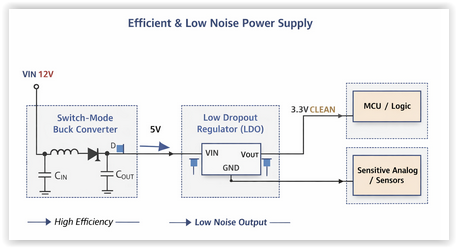
I plan to implement this in my next PCB-based node using a 5 V DD4012SA followed by an LD33CV. My design will include two 3-pin female headers for the combo. For indoor applications with a 5 V supply, the SMPS can be omitted and replaced with a simple wire link, making the same PCB suitable for multiple scenarios.


 But you get to try out all the beds! And your partner gets all those furniture ideas that you will never implement! And don't forget the meatballs lunch if you time it right.


